
AI has reached the office, not the operation
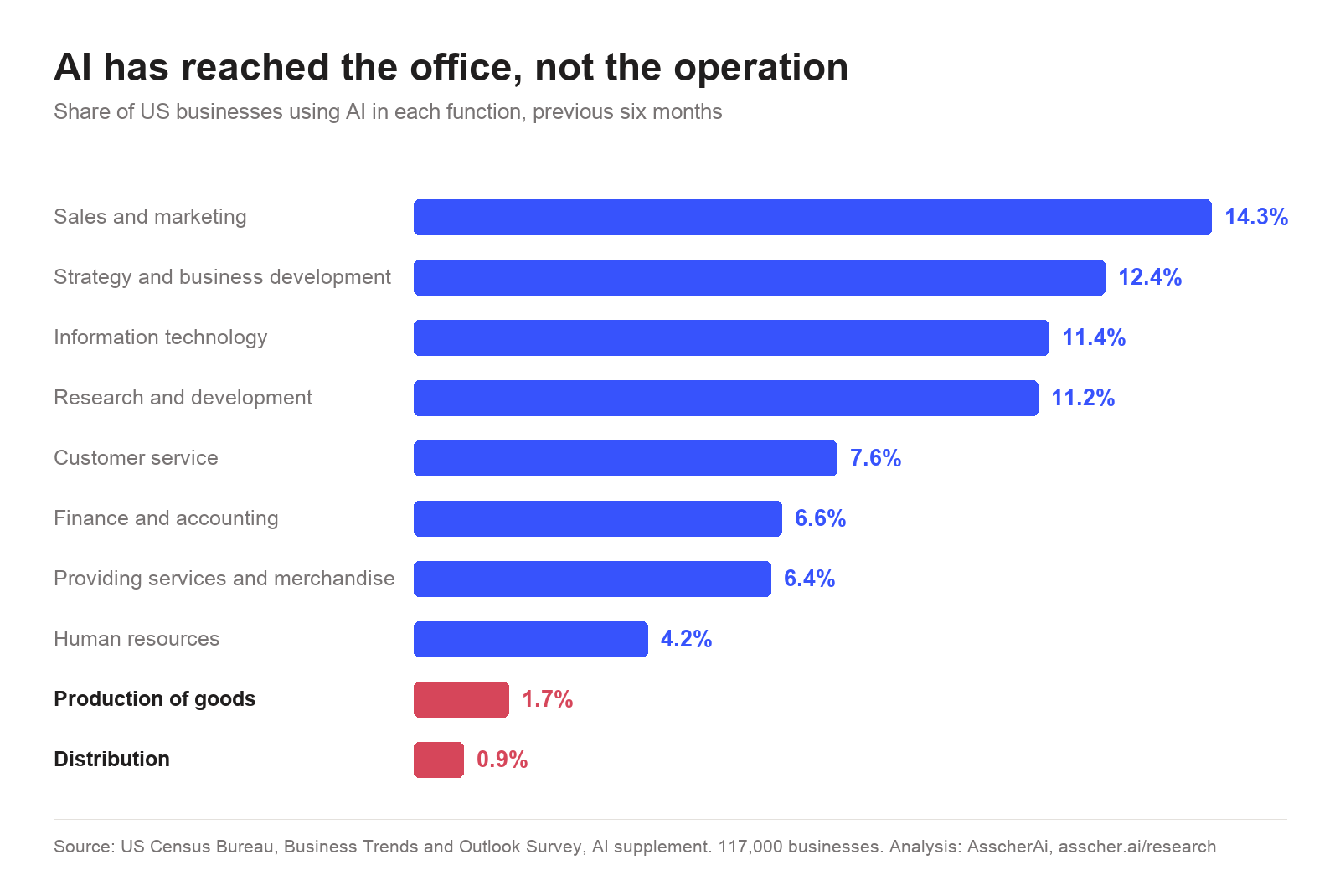
117,000 US businesses were surveyed by the Census Bureau. 22.4% used AI in the two weeks to July 2026, up from 17.3% nine months earlier. Adoption is concentrated in office work: 14.3% use AI in sales and marketing against 1.7% in production of goods and 0.9% in distribution. Among businesses already using AI, 64.3% made no operational change of any kind to adopt it.
The US Census Bureau asks 117,000 businesses what they actually do with AI, every two weeks, and publishes the answers for nothing. Almost nobody reads them. Here is what they say.
The measurement almost nobody reads
Most numbers about AI adoption come from vendor surveys of a few hundred self-selected respondents, usually commissioned by a company with something to sell. The Census Bureau's Business Trends and Outlook Survey is a different kind of instrument: a probability sample of US businesses, run continuously, with an AI supplement carrying 117,000 responses in this release. It is free, it is updated every two weeks, and it is almost entirely absent from the discussion.
We read it so that our own claims about industrial AI have something underneath them. What follows is that reading. Every figure is linked to the source workbook, and the extraction script is published so anyone can reproduce it.
Adoption is rising steadily, and it is not a hockey stick
22.4% of US businesses reported using AI in the two weeks to July 2026, up from 17.3% in November 2025. That is 5.1 percentage points in 40 weeks, or roughly 29% growth in nine months.
It is a straight line, not an inflection. Anyone planning on the assumption that AI adoption is about to go vertical is planning against this data rather than with it. The share expecting to use AI within six months sits consistently 3.5 points above actual use, and that gap has stayed roughly constant, which is what a steady rate of conversion looks like.
AI has reached the office. It has not reached the operation.
This is the finding that matters most, and it is the one nobody quotes. Split adoption by business function and the picture is not of a technology spreading evenly across a company. It is of a technology that has saturated the parts of a business that produce documents, and barely touched the parts that produce things.
14.3% of businesses use AI in sales and marketing. 1.7% use it in production of goods. That is a 8.4 to one gap between the commercial front of a company and its physical core. Distribution is lower still at 0.9%, sourcing, supply chains, and purchasing is 2.6%, and quality management and control is 2.8%.
Every function above 12.4% is an office function. Every function below 2.8% involves a physical object. The dividing line is almost perfectly clean, and it is not a coincidence: the functions AI has reached are the ones whose work product is text.
Manufacturing is not behind. It is differently behind.
The obvious reading is that heavy industry is a laggard, and the headline number supports it: 12.4% of manufacturers report AI use against 17.9% of businesses overall, and 37.6% in information.
But the function-level data complicates that story in a way worth sitting with. Manufacturers use AI in production of goods at 2.2%, above the 1.7% national figure, and in sourcing and supply chains at 3.4% against 2.6%. Where manufacturers fall behind is the office work: sales and marketing at 12.8% against 14.3%, strategy at 9.4% against 12.4%.
So manufacturers are not refusing AI. They are slightly ahead of everyone else at the thing that is genuinely hard, and behind at the thing that is easy. Their low headline number is mostly a measure of how little of a manufacturer's work is paperwork.
Where the intent is
Ask businesses that expect to use AI within six months which functions they have in mind, and the industrial functions show the steepest climbs from the smallest bases.
Quality management and control runs from 2.8% in use to 18.3% intended, sourcing, supply chains, and purchasing from 2.6% to 14.6%, production from 1.7% to 8.1%. Read carefully: this is not a forecast, and the two figures come from different populations, the second being businesses that have already decided they are adopting. It is a statement about where attention is turning, and it is turning toward operations.
Adoption is a subscription, not a programme
Here is the number that should trouble anyone selling AI transformation. Among businesses already using AI, 64.3% made no change of any kind in order to use it.
Only 15.4% developed new workflows. Only 6.8% changed how they collect or manage data. Only 3.8% used a vendor or consultancy to install or integrate anything, and just 1.3% hired anyone with AI skills.
This is what adoption looks like when it means buying seats for a chat tool. It also explains the function data: you can point a language model at a marketing email without changing anything about your company, and you cannot do that with a production line. The functions where AI has spread are exactly the functions where it required nothing of the business.
The corollary is the opportunity. The 1.7% figure for production is not evidence that AI cannot do the work. It is evidence that almost nobody has yet done the unglamorous part: getting the data into a state where a model can reach it.
The barrier is relevance, not cost
Businesses with no plans to adopt AI were asked why. The answers are not the ones the industry assumes.
61.6% say AI is not applicable to their business. 22% say they do not know what AI can do. Only 6.9% say it is too expensive and only 2.8% cite law or regulation. Privacy and security concerns sit at 20.7%, which is real but a third of the "not applicable" figure.
Price is not the objection. Regulation is not the objection. The objection is that a majority of businesses have looked at AI and concluded it has nothing to do with what they do. Whether that judgement is right is a separate question; that it is the prevailing one is the fact to plan around.
AI is not cutting headcount
Among businesses using AI, 95.7% report no change to total employment. 2% report a decrease.
The task-level data says the same thing from a different angle: 43.7% used AI to supplement or enhance work an employee was already doing, and 10.1% used it to perform a task previously done by an employee. Of those that did displace tasks, 70.9% describe the number as small.
Whatever is happening to employment in aggregate, the businesses actually using AI are not reporting it as a substitution for people. This is worth holding onto, because it contradicts both the marketing and the fear.
Scale helps, but less than you would expect
Adoption is essentially flat from 1 to 4 employees (17.6%) through 20 to 49 (18.5%), then climbs to 30.6% at 250 or more. A business with 250 or more employees is only 1.7 times as likely to use AI as one with fewer than five.
For a technology widely described as favouring scale, that is a modest advantage, and it fits the picture above: most adoption to date has been individual employees using tools that need no scale at all.
What we take from this
We build AI for large industries, so treat the following as an interested reading rather than a neutral one.
- The addressable gap is operational, not clerical. Office AI is close to saturated relative to how quickly it can be sold. Production, quality, supply chain and distribution sit between 0.9% and 2.8%, and the intent data says that is where attention is moving next.
- The work is data, not models. 64.3% of adopters changed nothing, and 6.8% changed their data practices. You cannot get to production-floor AI without doing the part almost nobody has done.
- Selling on cost savings from headcount is selling against the evidence. 95.7% report no employment change. The honest case is capability and speed of answer, not payroll.
- The biggest competitor is "not applicable". At 61.6%, indifference outweighs every practical objection combined. That is an education problem before it is a product problem.
Method, and what this data cannot tell you
Source: U.S. Census Bureau, Business Trends and Outlook Survey (BTOS), Artificial Intelligence supplement, 2025-2026. 117,000 responses, unit response rate 10%. Project No. P-7529868, Disclosure Review Board approval CBDRB-FY25-0425. Extracted 2026-08-30.
Standard errors on the national estimates are small, between 0% and 0.24% on the figures quoted here, so the gaps described above are far larger than sampling noise. The caveats that matter are different ones:
- Businesses, not employees or output. Every percentage counts firms, so a corner shop and a car plant weigh the same. Adoption weighted by employment or revenue would look considerably higher.
- Self-reported, and AI is a slippery word. 10.8% of businesses answered "do not know" to whether they used AI at all, which tells you how much definitional fog sits in these numbers.
- Two different windows. The headline adoption question asks about the previous two weeks; the function questions ask about the previous six months. They are not directly comparable and are not compared here.
- United States only. Nothing here should be read as a global figure.
- Intent is not a forecast. The "expect to use" figures come from businesses that have already decided to adopt, and people overstate intentions.
The extraction script and the parsed dataset are published in the open, so any number above can be checked against the Census workbook it came from. If you find an error in our reading, we want to know: tell us and we will correct it and say what changed.
The data, and a chart you may use
Every figure in this report is in one file, in the form it was read from the Census workbooks: download the dataset (CSV, 90 rows). It carries the trend, the sector and employment-size breakdowns, the business functions, what adopters changed, why non-adopters are staying out, and the reported effect on employment.
The chart and the data are free to republish, including commercially, with credit to AsscherAi and a link to this report. No permission needed and nothing to fill in. If you want a cut of the data we have not published, or the same breakdown for one industry, ask us and we will prepare it.
Frequently asked questions
What share of US businesses use AI?
22.4% of US businesses reported using AI in the two weeks to July 2026, according to the Census Bureau's Business Trends and Outlook Survey, up from 17.3% in November 2025. A further 3.5 points expect to be using it within six months.
Which business functions use AI the most?
Sales and marketing leads at 14.3% of all US businesses, followed by strategy and business development at 12.4%. The lowest are distribution at 0.9% and production of goods at 1.7%. Every function above 12.4% is an office function and every function below 2.8% involves a physical object.
How many manufacturers use AI?
12.4% of manufacturers reported AI use, against 17.9% of US businesses overall. But manufacturers use AI in production of goods at 2.2%, above the 1.7% national rate, and in supply chain at 3.4% against 2.6%. Their lower headline figure mostly reflects less office work, not less appetite.
Why do businesses not adopt AI?
61.6% of businesses with no adoption plans say AI is not applicable to their business and 22% say they lack knowledge of what AI can do. Cost is cited by only 6.9% and law or regulation by 2.8%. Indifference outweighs every practical objection combined.
Is AI reducing employment?
Not among the businesses using it. 95.7% report no change to total employment and 2% report a decrease. 43.7% used AI to supplement work an employee was already doing, against 10.1% who used it to perform a task previously done by an employee.
How much do companies change in order to adopt AI?
Very little. Among businesses already using AI, 64.3% made no change of any kind to adopt it. 15.4% developed new workflows, 6.8% changed data practices, 3.8% used a vendor or consultancy and 1.3% hired anyone with AI skills.